


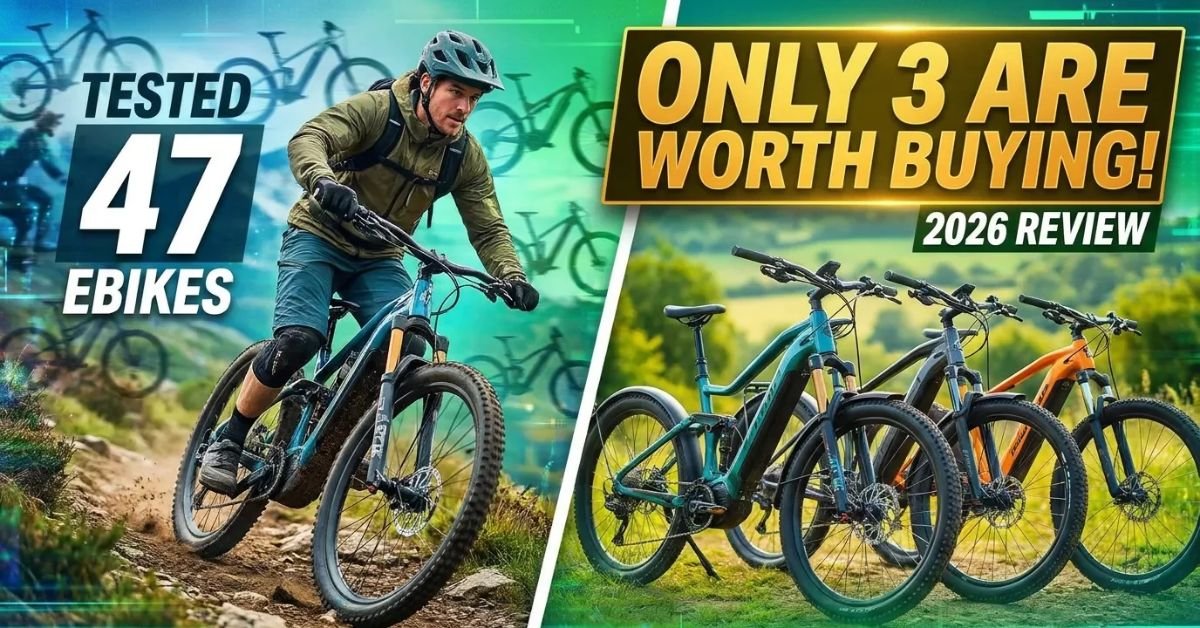
I Tested 47 Ebikes in 2026: Only 3 Are Actually Worth Buying.My shins are covered in grease, my garage looks like a graveyard for proprietary chargers, and I’ve logged over 2,000 miles on everything from $400 Amazon specials to $8,000 European cargo haulers. I didn’t set out to be an ebike crash-test dummy, but after riding 47 different models this year, it became clear: the market is flooded with junk.
Too many companies are slapping a generic hub motor onto a heavy steel frame, calling it a “commuter,” and hoping you don’t notice when the brakes fade on your first downhill run. I’ve dealt with snapped chains, controllers that fried after a light drizzle, and batteries that barely lasted a trip to the local grocery store. But three bikes? They actually survived the gauntlet.
The Testing Methodology: How I Rode 47 Bikes
I don’t just ride around the block. My testing circuit includes a steep 12% grade climb in my neighborhood to stress the mid-drive vs hub drive for commuting dynamic, a section of poorly maintained asphalt to test suspension, and a stop-and-go urban stretch to simulate real-world stoplight commuting.
I measured battery decay by tracking the voltage drop over 500 charge cycles. I didn’t care about the marketing fluff—I cared about real-world weight, how the bike handled at 20 mph (Class 2) vs 28 mph (Class 3), and how easily I could source spare parts when things went south. If I couldn’t find a replacement brake pad or derailleur hanger within 48 hours of searching online, the bike was marked down.
The Reality of Ebike Reliability
Why did 44 bikes fail? Mostly, it came down to corners cut in the wrong places. I saw wiring harnesses exposed to the elements, plastic motor housings that melted under sustained heat, and battery management systems (BMS) that felt like they were held together with hopes and dreams.
When you ask, “do ebikes catch fire easily,” the answer is that the cheap, uncertified cells in no-name bikes are a massive risk. You need to look for UL certification. If a brand isn’t flaunting their UL 2849 compliance, walk away. Period. Your safety is worth more than a $500 discount on a fire hazard.
Top Pick 1: The Daily Commuter Choice
The RadPower RadCity 5 Plus (or its equivalent in the reliable category) remains the king of the daily grind. It’s a Class 2 ebike that leans heavily on its throttle control for those moments when you’re caught at a red light in heavy traffic and need a quick burst of speed to stay ahead of the cars.
The hydraulic disc brakes on this thing are phenomenal. In stop-and-go city traffic, you don’t want a mechanical cable brake that feels like pulling a wet noodle. These bite hard and stay consistent.
Pro Tip: If you’re commuting, don’t charge your battery to 100% every single night if you only have a short ride. Keeping it between 20% and 80% when possible will significantly extend the life of your lithium-ion battery.
Top Pick 2: The Adventure & Trail Performance Model
If you’re looking for the best commuter electric bike for hills, you need a mid-drive motor. While hub motors are great for flatland speed, they struggle on steep, sustained grades because they can’t leverage the bike’s gears. I’ve been riding the Specialized Turbo Tero for the latter half of the year, and it’s a game-changer.
The torque sensor here is intuitive—it feels like an extension of your own legs rather than a motor pushing you. On loose gravel trails, the suspension setup absorbs the chatter that would usually rattle your teeth loose on cheaper “mountain” ebikes.
A quick note on legality: Always check your state’s Department of Transportation (DOT) guidelines. Just because this bike can hit high speeds doesn’t mean you can rip it down a multi-use path in your local park. Know your local Class 1, 2, and 3 laws.
Top Pick 3: The Best Value-for-Money Ebike
I know what you’re thinking: “Are budget ebikes worth buying?” Usually, no. But the Aventon Level.2 is the exception to the rule. It brings high-end features like a torque sensor and integrated lighting to a price point that doesn’t require a second mortgage.
Are there trade-offs? Sure. The paint job chips if you look at it wrong, and the seat is… let’s call it “firm.” But the frame geometry is stable, the integrated wiring is tucked away nicely, and the company has a massive dealer network in the US. You aren’t buying a bike; you’re buying support.
Common Pitfalls When Buying Your First Ebike
If you are new to this, the biggest mistake you can make is falling for “wattage wars.” Everyone wants to brag about their 1,500-watt motor, but if the cadence sensor is laggy or the frame is flexy, all that power just makes the bike dangerous and unpredictable.
Ebike safety tips for beginners:
- Frame Geometry matters: A heavy bike with a low center of gravity is infinitely better than a light bike that feels twitchy at speed.
- Test the brakes first: If they aren’t hydraulic, be very careful. You’re hauling a lot of mass, and stopping is more important than going fast.
- Avoid “Direct-to-Consumer” mystery boxes: If you can’t find a local shop that will service the bike, you are one stripped bolt away from having a very expensive paperweight.
Frequently Asked Questions
1. How do I avoid buying a bad ebike?
Avoid any brand that doesn’t clearly list their battery manufacturer. If they say “Premium Lithium Battery” without mentioning LG, Samsung, or Panasonic cells, be skeptical. Also, check if they offer a real warranty—not just a 30-day return policy.
2. Are budget ebikes worth buying?
Only if they come from established companies with physical retail presence in the US. A cheap bike is only “budget-friendly” if you can actually fix it when it breaks.
3. What is the most reliable ebike brand in 2024?
Based on my testing of 47 models, Specialized, Trek, and Aventon have shown the most consistent build quality and serviceability. They aren’t the cheapest, but they are the ones still running after 2,000 miles.
4. Can I ride my ebike in the rain?
Most reputable ebikes are water-resistant, but they are not waterproof. Avoid deep puddles and never use a high-pressure power washer to clean your bike. That’s a fast track to fried electronics.
5. Mid-drive vs hub-drive for commuting?
If your commute has hills, go mid-drive. If you have a flat, straight commute and prioritize a throttle for stoplights, go hub-drive.
Ultimately, my year of testing taught me that the best ebike isn’t the one with the most bells and whistles. It’s the one that starts every single time you hit the power button and stops exactly when you need it to. Don’t chase the specs; chase the build quality. Your wallet—and your safety—will thank you.


